





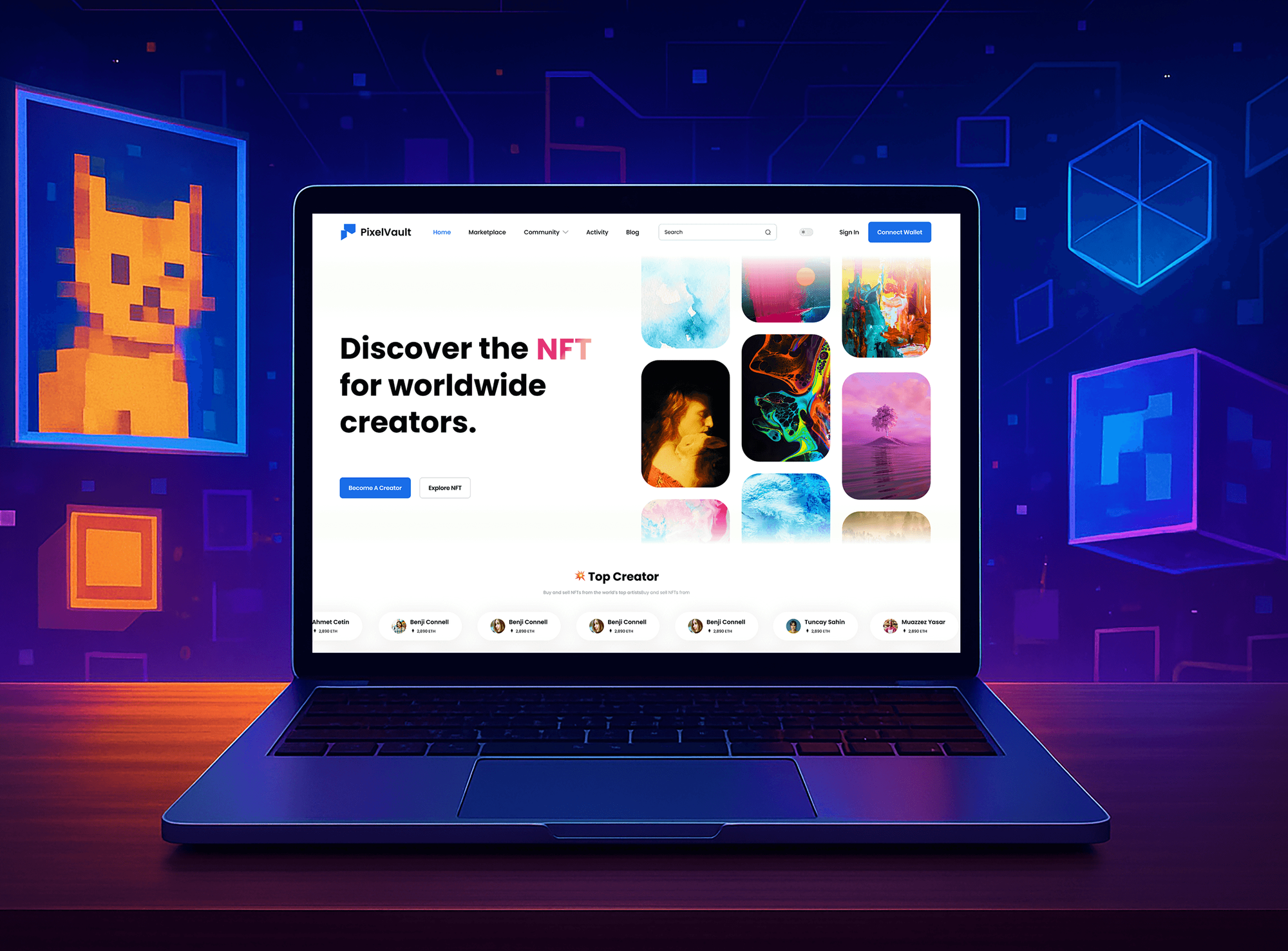
PixelVault NFT Marketplace Web Design & Development
- Crypto & NFT
- Dashboard
- Website

For marketplace teams whose filter URLs, expired listings, and seller duplicates hold back search: crawl rules, category pages from real inventory, and developer fixes. From $900 per month.
2X
More listing pages indexed
100%
Crawl rules for every facet
How your project runs
01 · FreeTeams we have built for:














The Problem
It shows up when Search Console reports far more discovered URLs than you have listings, most of them filters and expired items, while sellers say their new listings don't appear in Google.
Filters
Filter combinations fill the crawl with near-duplicate pages.
Filters
Only filters with real search demand get indexable pages.
Expired listings
Sold listings return empty pages or soft 404 errors.
Expired listings
Each listing state has a rule for its status code and similar items.
Duplicates
Several sellers post the same product with copied descriptions.
Duplicates
Duplicate offers merge into one product page with every seller listed.
Empty pages
Category pages for small towns show zero results.
Empty pages
Category and location pages publish only where inventory exists.
Search Console lists far more URLs than you have listings. Most are color, size, and price filter combinations, plus listings that sold months ago and now show an empty page. Several sellers list the same blender with the same copied manufacturer description. Category pages for small towns show zero results. New listings take weeks to appear in Google, so sellers blame your marketplace and post their stock somewhere else.
We start with crawl rules: which filter combinations deserve indexable pages and which stay out of the crawl, following Google's faceted navigation guidance. Sold and expired listings get a clear rule. Seller duplicates point to one product page with every offer. Category and location pages go live only where inventory exists. Our developers make the changes in your codebase, so Google spends its time on listings that can sell.
Crawl rules for filters
Which filter combinations get indexable pages and which stay out of the crawl, set per category.
Sold and expired listings
A rule for each listing state: sold, expired, out of stock, or removed by the seller.
Seller duplicates merged
Identical products from several sellers point to one product page that shows every offer.
Our Marketplace SEO Process
Your product and engineering leads approve each crawl rule, your marketplace team approves seller guidelines, and each month you see indexed listings and orders or bookings by page type.
We crawl a sample of your marketplace and read Search Console's indexing reports and, where available, your server logs. You get a short report on wasted crawl, duplicate listings, expired pages, and empty categories.
Projects We've Built
Marketplaces and booking platforms from our team, with listing pages, seller and host dashboards, and search filters. None is presented as an SEO result.


What's Included
A monthly program for marketplace websites: crawl rules for filters, listing lifecycle rules, duplicate handling, category and seller pages, and developer fixes in your codebase. Results are measured in indexed listings and orders.
Compare Options
A store SEO agency knows product pages, and your own developers know the codebase best. Marketplaces need both: search rules for many sellers and developers who can ship them.
| Feature | DeveloperLookBest fit | Store SEO agency | In-house team |
|---|---|---|---|
| Cost model | Monthly fee, fixes included | Monthly retainer | Salaries and roadmap time |
| Faceted navigation | Rules set per category | General best practices | Built, rarely tuned for search |
| Seller duplicates | Merged into one product page | Often not addressed | Possible with clear rules |
| Expired listings | Rule per listing state | Handled case by case | Depends on the backlog |
| Code changes | Made by our developers | Tickets for your team | |
| Speed to ship fixes | 4 to 6 weeks from the audit | Waits on your developers | Fast once prioritized |
| Monthly reporting | Indexed listings and orders | Rankings and traffic | Engineering metrics |
| Knowledge of your code | Learned during the audit | Limited to the storefront | Deep and daily |
What Our Clients Say
Feedback from teams we have built and launched websites for.
We had a pretty specific idea of what we wanted our website to become, but I wasn’t sure how easily we could explain all of it to a development team. There were quite a few moving parts, and we were working toward a deadline, so I expected a few things to get lost along the way. That never really happened. They understood what we were trying to achieve, kept us updated throughout the process, and got everything ready within the agreed timeline. The final site feels much easier to navigate, works beautifully on mobile, and is noticeably smoother for our customers. It was a huge relief seeing the original idea actually turn into the website we had in mind.
The mobile experience is probably my favourite part of the new site. We had spent a lot of time making sure the desktop version looked right, and the team kept pushing us to think about how everything would actually feel on a phone too. They were right. The navigation is clean, the interactions feel natural, and everything we’ve tested so far works exactly as it should. They also went through the links, forms, integrations, and other details more than once before launch, which I really appreciated. And even after going live, we could still reach out when something came up. The whole process felt friendly, organised, and surprisingly straightforward.
What I appreciate most is that the website is actually easy for us to manage now. We can update content ourselves instead of sending a developer a message every time we need to change something small. They also paid attention to the technical SEO side, which mattered to us because we didn’t want a new website to create problems for the traffic we already had. I’ve probably asked more questions than I should have since launch, but every question has been handled patiently and without any fuss. The team is easy to work with, they explain things clearly, and when we need something changed, they focus on getting it done rather than making the process complicated.
1,250+
Projects shipped
10+
Years of experience
Top 3%
Upwork Top Rated Plus
5 stars
Average review score
1,250+
Projects shipped
10+
Years of experience
Top 3%
Upwork Top Rated Plus
5 stars
Average review score

Want results like these?
Tell us what you are building. You get a reply within 24 hours on business days, then a written estimate.
Work Culture
Search work for a marketplace lives in the code, the crawl, and the seller experience at once. These habits keep every change safe to ship and every result measured in listings that sell.
Our developers change robots rules, canonicals, and templates in your codebase and send them through your review process. Recommendations that sit in a backlog don't change rankings.
New crawl rules go live on one category before the whole site. Search Console data from that sample shows whether a rule helps before we roll it out.
Listing guidelines help sellers write unique titles and descriptions without slowing them down. A rule that frustrates sellers costs you supply and fresh listings.
We don't mass-produce empty location or category pages to chase keywords. Google's spam policies target scaled pages with little value, and marketplaces are exposed.
Reports track indexed listings and the orders or bookings they bring, not just traffic. You see which page types earn the crawl they get.
Every change lives in your repository, and Search Console stays under your company's login. If you stop working with us, nothing needs to be undone.
Overview
DeveloperLook provides marketplace SEO for multi-vendor, rental, and service marketplaces. We set crawl rules for filter URLs, handle sold and expired listings, merge seller duplicates, and build category pages from live inventory, with developer fixes included. Plans start at $900 per month, and developer fixes ship within 4 to 6 weeks.
DEVELOPERLOOK
Project facts · Marketplace SEO
Reviewed 28 Oct 2026 by Saimul Islam
Good fit
Product marketplaces with many sellers
Your marketplace lists products from many sellers, and you need SEO for marketplace sites that stops filter URLs and duplicates from eating the crawl.
Rental and service marketplaces
Your platform connects renters or customers with local providers, and you want marketplace SEO services that build location pages only where providers exist.
Marketplaces after a replatform
You moved from a custom build to Sharetribe or CS-Cart and lost traffic, and you need a marketplace SEO expert to find what the migration broke.
B2B and wholesale marketplaces
Your buyers search by part number and spec, and you want marketplace SEO optimization services that turn supplier catalogs into findable product pages.
Agencies building marketplaces
Your agency builds marketplace platforms, and you need a marketplace SEO agency to handle crawl and listing rules under your brand.
Not a fit
Selling on Amazon or Etsy
You sell on someone else's marketplace, such as Amazon or Etsy, rather than running one. Listing optimization on those platforms isn't a service we offer.
Marketplace not built yet
You still need the marketplace itself. Our Multivendor Marketplace Development service builds it with search rules in place from the start.
Single-brand online store
You run one store selling your own products. Our Ecommerce SEO Services page fits a single-seller store better.
Budget under $900 a month
Your catalog is small enough for a one-time cleanup. Our Technical SEO Services page offers one-time fixes, and we'll tell you before we quote if that's enough.
Not sure we're the right fit?
Book a free call or message us. We'll tell you honestly whether we're the right team.
Pricing
These are monthly starting points in USD. Your plan depends on listing volume, listing types, and regions, and you get a fixed proposal after a free crawl audit.
For Agencies
Your agency keeps the marketplace client. We set crawl and listing rules, make the code changes in your stack or theirs, and report indexed listings. Your team presents the work under its own name.
White label: your client only ever sees your brand
Send repository access, Search Console, platform details, and your listing types.
We audit the crawl and send one fixed monthly price.
Fixes merge through your agency's process, and you present the results.
Send repository access, Search Console, platform details, and your listing types.
We audit the crawl and send one fixed monthly price.
Fixes merge through your agency's process, and you present the results.
The Right Technology for Your Project
Tools we use to read how Google crawls your marketplace, change the code that controls it, and track indexed listings and orders.
 Google Search Console
 Semrush
 Magento
 WooCommerce
 Algolia
 Next.js
 React
 Node.js
 Google Analytics (GA4)
 Google Tag Manager
 Google Sheets
Related Services
Services that pair with marketplace search: the core SEO program, marketplace development, ecommerce SEO, technical SEO, programmatic SEO, and WooCommerce multi-vendor builds.
This page
Marketplace SEO
Pairs with the 6 services around it
FAQ
Straight answers on marketplace search: what it is, cost, timing, filters, expired listings, duplicates, audits, and ownership.
Saimul IslamFounder & CEO, DeveloperLookStill have questions?
Send a message or book a call with the team.
Marketplace SEO is search work for websites where many sellers list products or services, such as multi-vendor stores, rental platforms, and service directories. It focuses on crawl control, listing and category pages, seller pages, and duplicate offers. Most of the work happens in templates and code, not on single pages.
A marketplace has far more URLs it doesn't write itself: listings from many sellers, filters, seller profiles, and listings that expire daily. A single store writes its own product pages. Marketplaces need rules that work at scale, plus guidelines that help sellers write listings worth indexing.
Our plans start at $900 per month for crawl rules, listing lifecycle fixes, and developer changes on one marketplace. Inventory Pages at $1,450 per month adds category, location, and seller pages plus duplicate merging. Scale Program at $2,300 per month adds monthly log analysis, hreflang, and pages that recruit new sellers.
Developer fixes ship within 4 to 6 weeks of the audit, and crawl stats in Search Console usually shift within a few weeks after that. Indexed listings and organic orders build over 3 to 6 months. Large marketplaces often see crawl changes first, because Google revisits their busiest sections often.
Give indexable pages only to filter combinations with real search demand, such as category plus brand or category plus city. Keep the rest out of the crawl with robots.txt rules, as Google's faceted navigation guidance recommends, and return a 404 for combinations with no results. Keep filter order and URL separators consistent.
It depends on whether the item can return. A listing that is out of stock or likely to be relisted stays live with its availability marked. A one-off item that sold can keep its page with a sold notice and similar listings, or return a 404 or 410 once it has no value. We set one rule per listing type.
Point every seller's offer to one product page that lists all the offers, instead of letting copies compete. Product markup on that page can describe offers from several sellers. Listing guidelines then help sellers add their own details, such as condition or bundle contents, without creating a new page.
They cover crawl waste, indexing gaps, duplicate listings, expired pages, empty categories, and links between categories, listings, and sellers. Where you share server logs, the audit shows which URLs Googlebot actually spends its time on. You get a ranked list of fixes with the developer effort for each.
Index seller pages once they have enough active listings and reviews to help a searcher. New or empty seller pages add little and can look like thin content, so they stay out of search until they qualify. The threshold is set per marketplace and applied automatically in the template.
You do. Every change lives in your repository and goes through your review process, and Search Console, analytics, and sitemaps stay under your company's accounts. If you leave, you keep the written crawl and listing rules and the audit history, so your developers can maintain them without us.
Saimul IslamFounder & CEO, DeveloperLookStill have questions?
Send a message or book a call with the team.
Free 30-min callGoogle Meet
Book a call
In 30 minutes on Google Meet we walk you through how we would build it, how long it takes and what it costs. Then you get a written estimate.
Calendar not showing? Book on cal.com or send a brief.